
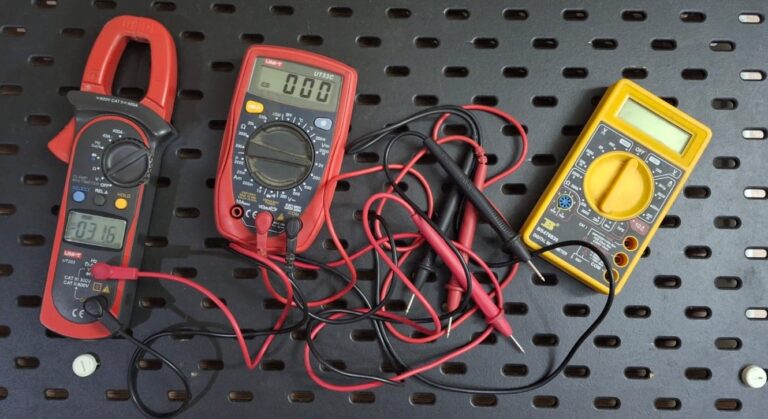
The DIY Guide to Mastering the Digital Multimeter
A multimeter is a versatile and affordable superhero for diagnosing electrical issues around your home, workshop, or garage. For DIYers, mastering this tool is crucial for effective electrical troubleshooting, as it can help you fix problems yourself, identify issues before they become dangerous, and save money by avoiding unnecessary electrician calls.
What Exactly Is a Multimeter?
It is a small, portable device used to measure three fundamental electrical properties: voltage (V), current (A), and resistance (Ω). Modern multimeters are typically Digital Multimeter (DMMs), featuring an easy-to-read screen and a selector dial.
Depending on the model, a multimeter can also check things like continuity, frequency, temperature, and whether complex components like diodes or capacitors are functioning. For beginners, a digital multimeter is generally recommended as it is easier to read and safer.
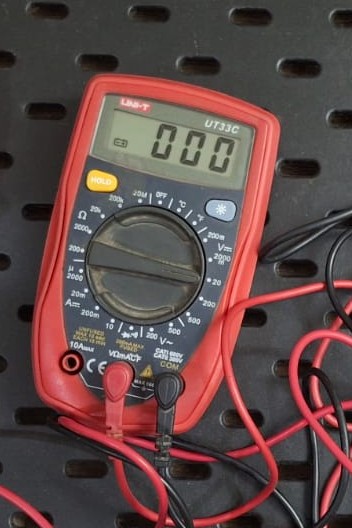
Multimeter Basics: Know Your Settings
The selector dial allows you to choose what property you want to measure. Key elements are:
- Voltage (V): Measures the power in a circuit. Household current uses AC voltage (Alternating Current), often marked as “V” with a wavy line over it. Batteries use DC voltage (Direct Current), marked as “V” with a solid and dashed line above it.
- Resistance (Ω): The Greek letter omega (Ω) signifies resistance, measured in ohms. This setting helps identify breaks in a circuit.
- Current (A): The letter “A” stands for ampères or amps, used to check the flow of electricity.
- Continuity: Often combined with the resistance setting, this mode is typically marked by a soundwave symbol or a sideways wireless reception symbol.
Setting Up and Testing Continuity
Continuity testing confirms the presence of a complete path for current flow. It’s the simplest and most common test for DIY diagnostics:
- Set the Mode: Turn the dial to the Continuity Test mode. On many meters, this mode activates an audible indicator (a beep) when continuity is detected.
- Connect Leads: Insert the black test lead into the COM (common) jack and the red lead into the VΩ jack.
- Test: With the circuit de-energized (power off!), connect the test leads across the component.
- Interpret: If the DMM emits a beep, a complete path (continuity) exists, indicating low resistance. If the DMM does not beep and displays “OL” (Overload) or infinity, the circuit is open or broken.
5 Essential Multimeter Diagnostic Uses
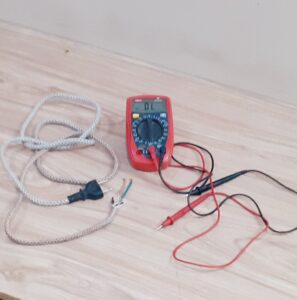
1- Test for Broken Wires or Cables: Use the continuity setting to check if current can flow from one end of a wire or extension cord to the other. If there is no sound, the wire is broken.
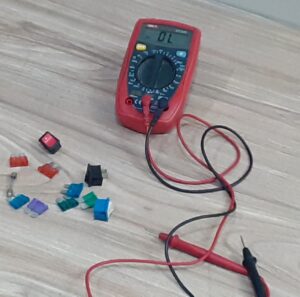
2- Check Fuses: Set the multimeter to continuity or resistance (Ω) mode. After removing the fuse, touch one probe to each end. A good fuse should show continuity (low resistance/a beep), while a blown fuse will show infinite resistance or no connection.
3- Diagnose Light Switches: Use continuity mode. With the circuit breaker off and the switch disconnected, place the probes on the terminals. When you flip the switch to ON, the multimeter should beep; if it doesn’t, the switch is faulty.
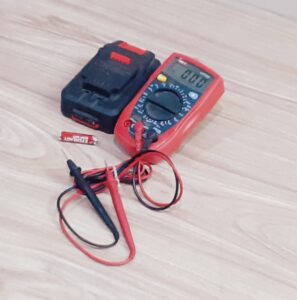
4- Test Household Batteries: Set the dial to DC voltage (V⎓). Touch the red probe to the positive (+) terminal and the black probe to the negative (-) terminal. A healthy AA battery should register above 1.5V.
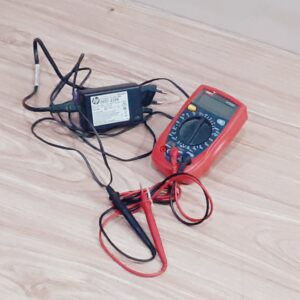
5- Test DC Power Adapter Output Voltage: This is for checking the small “wall wart” power supplies used for routers, modems, or small electronics. Set the multimeter to DC voltage (V⎓) to verify the adapter is supplying the correct voltage (e.g., 9V, 12V, or 5V) as indicated on its label.
How to Buy the Right Multimeter
Choosing the right meter depends on your budget and project complexity.
- Go Digital: Digital multimeters (DMMs) are highly recommended, offering ease of reading and increased safety for beginners.
- Auto-Ranging Feature: If you are a beginner, look for an auto-ranging multimeter. This feature automatically selects the correct measurement range, making it much easier to use, especially for voltage measurements. Meters without this (manual range) require you to set the appropriate scale, which can be challenging.
- Consider True-RMS: A True-RMS meter (like the Fluke 117 or AstroAI 6000) can measure complex electrical waveforms more accurately, which is beneficial if you plan on working on HVAC systems or variable motor drives.
- Check the Safety Rating (CAT): The Category (CAT) rating indicates the voltage level the meter can safely handle. For most at-home use, a CAT II level (suitable for testing standard outlets) is appropriate.
- Look for Durability: If your meter will be used on job sites or subjected to rough use, consider models with a rubberized exterior casing for protection against drops and falls.
Safety First: Essential Multimeter Precautions
Working with electrical systems is inherently dangerous. Always follow safety procedures when using your multimeter:
- De-Energize Circuits for Resistance/Continuity: Always turn off the power to the circuit or device before measuring resistance or continuity. Attempting to read resistance on a hot circuit can confuse the meter and lead to inaccurate readings.
- Wear Protection and Use Caution: If testing live electricity, wear rubber gloves if you are nervous. Use one hand to hold both probes; this prevents current from running through your chest if you receive a shock.
- Mind the Leads: Keep your fingers behind the probe guards. Never let the probes touch each other when inserted into an outlet.
- Set the Dial Correctly: Double-check that you have set the multimeter to the correct mode (AC for household power, DC for batteries) and the appropriate range before testing.
- Use the Right Ports: Ensure the red probe is plugged into the correct jack (usually VΩ for voltage, resistance, and continuity, or the ‘A’ port only if measuring high current).
- Understand Voltage Needs Potential Difference: When measuring voltage, you must connect the probes across two different points (e.g., hot to neutral, or positive to negative) to measure the difference in potential; connecting both probes to the same wire will result in zero voltage.
If you are unsure or confused about what you are doing, do not proceed; call a licensed professional.
A multimeter is like having a pair of diagnostic glasses for your home’s wiring—it lets you see the invisible flow of electricity, revealing whether power is flowing correctly, where a break lies, or if a battery is truly dead. Embrace this tool, and you’ll become a far more effective DIYer.
Hi there! This is my first comment here so I just wanted to give a quick shout out and tell you I genuinely enjoy reading your
blog posts. Can you suggest any other blogs/websites/forums that cover
the same subjects? Thank you!