
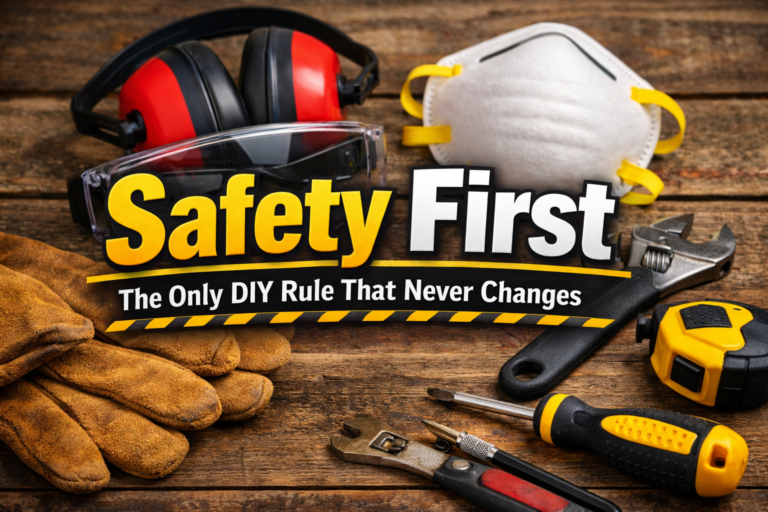
DIY is empowering. It saves money, builds confidence, and turns ordinary homeowners into capable problem solvers.
But there is one rule that sits above every tool, tutorial, and technique:
Safety always comes first.
Not speed.
Not savings.
Not curiosity.
This article explains what “safety first” actually means in real-world DIY—and how adopting this mindset separates responsible DIYers from dangerous ones.
Why Most DIY Accidents Happen
DIY injuries rarely happen because someone lacked skill.
They happen because someone:
- Assumed power was off
- Rushed to “just finish it”
- Skipped protection for a “small job”
- Tried to fix before understanding the problem
In other words, accidents happen when thinking stops before tools come out.
Safety is not about fear.
It is about control.
Safety Is the First Skill You Must Learn
Many beginners think safety comes after learning tools.
In reality:
Safety is the first DIY skill—everything else builds on it.
Before you learn how to drill, cut, wire, or repair, you must learn how to:
- Identify hazards
- Control energy
- Respect limits
A DIYer who understands safety but lacks experience will progress safely.
A DIYer with experience but poor safety habits will eventually get hurt.
Understand the Hidden Dangers in Homes
Homes contain more hazards than most people realize:
- Electricity hidden behind walls
- Stored energy in capacitors and springs
- Water pressure that can release suddenly
- Sharp edges inside “harmless” appliances
- Dust that damages lungs over time
DIY safety begins with accepting one truth:
If you can’t see the danger, it doesn’t mean it isn’t there.
Control Energy Before You Control Tools
Every safe DIY task begins by controlling energy.
That means:
- Switching off and isolating electrical power
- Releasing water pressure before plumbing work
- Discharging stored energy in devices
- Securing loads so nothing can move unexpectedly
Rule:
If energy is not isolated and verified, the job does not start.
Electrical DIY: Clear and Firm Boundaries
Electricity deserves special respect.
As a DIYer, you must NEVER:
- Work on live circuits
- Assume power is off without testing
- Touch exposed wiring without verification
Safe electrical DIY always follows this sequence:
- Switch off at the source
- Isolate
- Test and confirm power is off
If it cannot be done with certainty, the task is not DIY-safe.
Personal Protective Equipment Is Not Optional
Many DIY injuries are preventable with basic protection.
At a minimum:
- Eye protection for drilling, cutting, sanding
- Gloves appropriate to the task
- Dust masks when sanding or handling fine particles
- Hearing protection during prolonged power-tool use
If protection is required and not available, the task must wait.

That is not caution—it is competence.
Know What Beginners Should and Should Not Do
A safety-first DIYer respects boundaries.
Generally Safe for Beginners
- Furniture tightening and repair
- Replacing switches or sockets after power is verified off
- Minor plumbing fixes (washers, traps)
- Appliance inspection after isolation
Not Beginner-Safe
- Live electrical work
- Gas systems
- Structural or load-bearing modifications
- Roof work without proper access equipment
Stopping is a safety decision—not a lack of ability.
A Safe Workspace Is a Safety Tool
Before starting any task:
- Ensure good lighting and ventilation
- Clear the area of children and pets
- Secure the workpiece properly
- Maintain stable footing and posture
Most injuries happen not because of the task—but because the workspace was uncontrolled.
The Most Important Safety Skill: Knowing When to Stop
Professional tradespeople stop work all the time.
You should too.
Stop immediately if:
- Something doesn’t behave as expected
- You feel unsure or rushed
- The situation no longer matches what you planned
DIY is not a test of bravery.
It is a practice of judgment.
Preparedness Is Part of Safety
Before starting any DIY task:
- Know how to shut off power and water quickly
- Keep a basic first-aid kit nearby
- Have a clear exit path
Safety planning includes planning for what could go wrong.
Safety Builds Better DIYers
When safety comes first:
- Confidence grows naturally
- Mistakes become learning, not injuries
- Skills compound over time
- DIY remains enjoyable and sustainable
The best DIYers are not the fastest or boldest.
They are the ones who go home uninjured—every time.
At Genuine DIY, Safety Is Non-Negotiable
Every guide, checklist, and tutorial on this site is built on one principle:
If it cannot be done safely, it should not be done at all.
Because no repair is worth your health.
And no project is worth regret.
Safety first. Always.